Workers in Informal Employment: Organising and Bargaining Collectively
- FREE
- 3 h 11 min
- English
- Interdisciplinaire, Science politique, Sciences sociales et humaines, Économie
- avec certificat
What is the course about?
This course offers a platform to analyse and discuss the political economy of informal employment and forces driving it. Our focus is on worker collective power and specifically on strategies for collective organising and bargaining in spaces where worker rights are commonly denied.
Across the four content chapters, we will get to learn more on themes such as: workers in informal employment organising and bargaining collectively to resist and overcome their exploitation; the power structures and forces that drive and sustain informalisation, and critical reflections on questions of worker collective power and action, including collective bargaining.
Check our trailer here.
Key concepts
Informal employment, informalisation of work, political economy of labour, key drivers of informality, precarity, collective representation, worker collective power, and collective organising and bargaining.
Course materials and workload
This course has 4 content chapters. A chapter contains a series of units; each unit is composed of one video lecture, two quiz questions, one exercise, one key reading (the link of which is provided right under the video) as well as additional readings (under the Additional Materials tab). All the course materials, including video scripts, can be downloaded and used offline. Zoom workshops with the course experts are recorded and added to the course content for those interested in going deeper into the issues discussed in each video lecture.
The estimated workload for each chapter is about 8 hours.
Course certificates
Certificate of Participation (CoP): can be obtained for free once you have completed 80% of the course.
Certificate of Accomplishment (CoA): can be issued only by the Global Labour University Online Academy. For details on the requirements, read carefully the information in Chapter 1, Unit 2.
Course content
Chapitre
1
Course Introduction
Chapitre
2
Organising and bargaining against all odds: stori…
Chapitre
3
The political economy of informal employment: unm…
Chapitre
4
Workers collective power: forms of collective rep…
What will you learn?
Upon completing this online course, the course participants will be able to:
- understand how various groups of workers in informal employment experience precarity; analyse the factors that constrain and facilitate their collective action; as well as draw analytical insights on the conections, similarities and differences from such actions;
- apply the arguments and learnings from the case studies and argue on the merits of alternative strategies from those currently pursued;
- understand the political economy of informal employment, the power relations, forces, and discourses that drive and sustain the informalisation of work and apply this analysis to their own context; and
- examine the concept of workers’ collective power, and challenge dominant narratives and terminologies that undermine the project of building such power.
What is the target audience?
workers, trade unionists, labour and other activists, labour researchers and practitioners, NGOs, students, media and others.
What prior knowledge is required?
This is a multi-disciplinary course drawing on the fields of social, political and economic sciences. It is at the level of a Masters’ programme, but the concepts are explained in an accessible language and illustrated through examples. Therefore, it is also possible to participate in the course using the skills and knowledge acquired. The course requires a working level of English.
Course instructors

Edlira Xhafa
Edlira Xhafa is the Executive Director of the Online Academy of the Global Labour University. She has a master's degree in Labour Policies and Globalisation from the Global Labour University (Germany) and holds a PhD in Labour Studies from the University of Milan, Italy. Since 2000, she has been engaged with national trade unions in her home country Albania, as well as in the Philippines, Bangladesh, Cambodia and Myanmar. She has also worked for, and collaborated with Education International, Public Services International, Building and Wood Workers' International, International Labour Organisation, Friedrich Ebert Stiftung and others.

Monsieur Md Sabbir Hossain

Gene Rodriguez


Monsieur Faisal Makruf

Oksana Abboud
StreetNet International Organizer

Martha Chen

Kate Lappin
Asia Pacific Regional Secretary, Public Services International (PSI)

Melisa Serrano
School of Labor and Industrial Relations, University of the Philippines
I teach courses on theories in industiral relations, labour and the economy, industrial relations and national development, and human resource development at the national level. My research involves the following topics: non-standard and precarious employment in ASEAN and East Asia; collective representation and collective action among workers in informal employment; union renewal; the informal economy; industrial relations in micro and small enterprises; trade unions and social movements; comparative industrial relations; wages and productivity in the Philippines; and 'alternatives' to capitalism. I engage with trade unions and other worker organisations in the Philippines and in other countries in terms of collaborative research, training and education, program development and evaluation, and other forms of technical support.
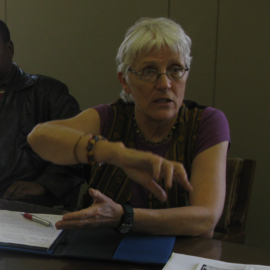
Madame Pat Horn
Collective Bargaining specialist, WIEGO (Women in Informal Employment: Globalising & Organising) & founder of StreetNet International
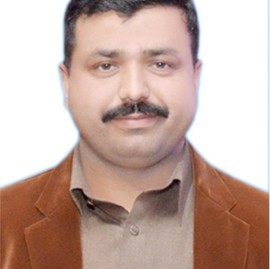
ASAD MEHMOOD

Madame Leelavathi Subramani
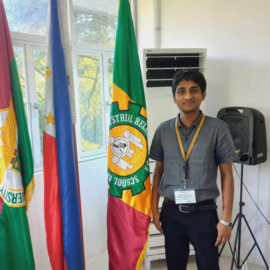
Monsieur Shalith Shamilana Bandara Athurupana
As a Critical Care Nursing Officer at the National Hospital of Sri Lanka in Colombo, I am proud to be part of the Public Services United Nurses Union (PSUNU), the largest union in Sri Lanka. Serving as an executive committee member of the union, I have joined hands with Public Services International (PSI) as a youth unionist working as the National Youth Coordinator in Sri Lanka.
As a nursing professional, I am dedicated to advancing the nursing profession and advocating for the rights of nurses. Thus, I work closely with the main professional associations in nursing, serving as the General Secretary of the Sri Lanka Nurses Association and as the President of the Sri Lanka Intensive Care Nurses Association.
I am committed to improving the quality of healthcare services in Sri Lanka, especially in critical care. My experience and dedication to the nursing profession make me a valuable asset to any organization.